One Name for Everything: .locker’s Ethereum Upgrade is a Game Changer
Think about how many different logins, payment apps, and addresses you use just to exist online. One name for your email. Another for your bank app. A long string of random letters and numbers if you've ever used cryptocurrency. None of them talk to each other, and none of them are easy to remember.
A .locker name was built to fix that. .locker is one unified identity that works as your website, your email, and your digital wallet address, all at once. Starting September 1, that identity gets significantly more powerful, thanks to new integration swith Ethereum, the largest blockchain community, and ENS (Ethereum Name Service). .locker remains a real, accredited domain name. It's the same kind of accreditation .com and .org have. .locker works in any browser, out of the box. The Ethereum integration adds blockchain capability on top of that; it doesn't change what .locker fundamentally is.
Quick refresher: what's a domain name, again?
A domain name is the address people type to find you online, like the "yourname.com" in a web address. It's also usually attached to your email. Domain names are managed through a global system that keeps the internet organized and makes sure names are unique. .locker is a domain name, accredited the same way .com is, which is what makes it work reliably in any browser.
Where .locker goes further is by also working as a digital wallet address. Instead of sending someone a digital payment to a string like 0x8f3a...c2d1, you can send it to hello.locker through compatible wallets and applications. Digital wallets are made possible by connecting to Ethereum, which is essentially a global, shared computer that a huge number of apps and services are built on top of. When a domain name is "on Ethereum," it means that the network recognizes the name and can use it the same way it uses those long digital wallet addresses. The system that organizes the names and data is called ENS (Ethereum Name Service).
.locker is a different kind of domain name. It's an accredited domain name first. The Ethereum integration doesn't change that; it adds a second layer on top of it. That combination of a real domain with a secure, reliable bridge to a blockchain is rare. Most names are built for one world or the other. .locker is built to move between both.
What's actually changing
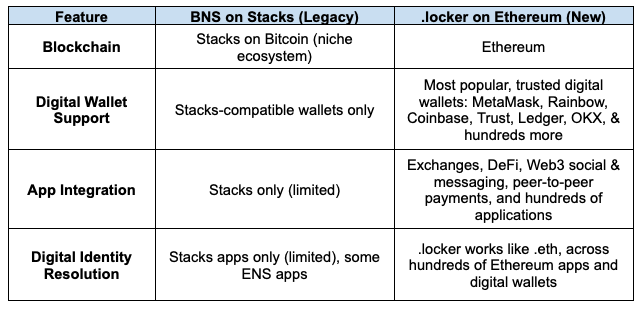
Since last year, .locker names have been able to point to an Ethereum digital wallet address, sort of like a forwarding address. Starting in September, that changes: .locker names will be issued directly on Ethereum through ENS, not just pointed toward it.
The difference matters more than it might sound. A forwarding address gets you found. Actually being issued on Ethereum means your .locker name can fully participate in everything Ethereum is used for, not just be looked up on it. It puts .locker on equal footing with .eth, the most established domains in the Ethereum world, while still working everywhere a regular domain name does.
What a .locker name can do
Send and receive digital payments. Skip the long digital wallet address. Anyone with a standard digital wallet, like MetaMask, can send a payment straight to a .locker name.
Log into apps. Many apps and services let users sign in with a digital wallet instead of a username and password. .locker names can serve as that credential, so users aren't creating (and forgetting) yet another login.
Host a real website. Because .locker works with standard web browsers, users can launch a website under the same .locker domain name.
Send and receive email. A .locker name can be used to set up a custom email address, the same way any domain name does.
All under one .locker name.
If a user's .locker name was set up before this update, they don't lose anything. They can choose to upgrade it to the new version. If they have questions or want to initiate the upgrade, our support team can assist.
The bigger picture
The internet has always asked people to keep track of a dozen different addresses, usernames, and logins just to get through the day. .locker is built on the idea that it shouldn't have to work that way, that one unified identity should be able to do all of it: be found, get paid, log in, and stay in touch. This update is the clearest step yet toward that, and we don't think it'll be the last.
To learn more about .locker, visit my.locker.
The $320B Stablecoin Market Needs an Identity Layer
Stablecoins hit $320B, but wallet addresses still can't tell you who you're paying. See how .locker adds a human-readable onchain identity layer to crypto payments.
September 30, 2026